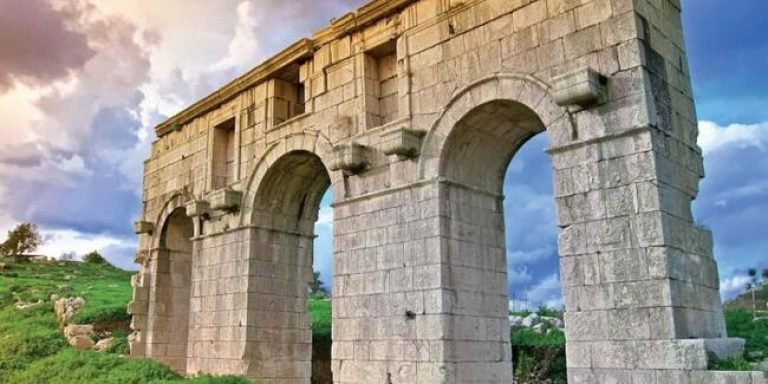
About Patara
Patara, one of the 16 cities of the Lycian League with voting rights, was among the cities besieged by Alexander the Great. According to mythology, Patara was founded by Paturus, the son of Apollo, together with the water nymph Lycia. It is also believed that Saint Nicholas (Santa Claus) was born in Patara. An important trade center during the Roman Period, Patara maintained its significance throughout the Byzantine Era as well. Patara Beach, located on the coastline of the Ancient City of Patara, offers visitors a unique experience combining rich historical and cultural heritage.
History of Patara
The name of the city appears as “Patar” in Hittite texts dating back to the 13th century BC. Pottery sherds unearthed at the Tepecik Acropolis display characteristics of the Middle Bronze Age, while a stone axe from the pre–Iron Age, found on the eastern slopes of Tepecik, demonstrates how far back the history of Patara extends. As the only harbor providing access to the sea from the Xanthos (Eşen) Valley, Patara remained an important city throughout history. In Lycian inscriptions and on coins, the city is referred to as Patara.
In the 3rd century BC, under Ptolemaic rule, Patara became the leading city of Lycia. At the beginning of the 2nd century BC, when Lycia came under the control of the Seleucid Kingdom, Patara was recognized as the capital of Lycia. This status was officially confirmed in 167/168 BC, when Patara gained autonomy from Rome and independence from Rhodes, becoming the capital of the Lycian League. Monumental structures such as the Parliament Building and the Theater, built during the Hellenistic Period, reflect this important historical process.
According to Legend
One day, Poseidon, the god of the seas, storms, and high waters, became furious with the Lycians. In his rage, he sent violent waves and sandstorms crashing onto the shores of Patara. For days and weeks, the disaster did not cease. The prayers, vows, and spells of the people of Patara proved futile. Finally, the city’s great oracles gathered and made a decision: all the women of Lycia would unite, gather on the beach, and undress before Poseidon. When the Lycian women gathered and began to undress against the raging waves, Poseidon was embarrassed, and suddenly everything fell silent—no fierce waves, no sandstorms.
Patara Through the Ages
Patara continued to be an important center throughout the Middle Ages and has survived to the present day with the arrival of the Turks in the region. Today, the entrance to the ancient city is through a magnificent and well-preserved Roman triumphal arch. On the western slopes beyond the arch lies the necropolis, featuring Lycian-type sarcophagi. Other visible remains include the Vespasian Bath, the Corinthian Temple, the main street, the harbor, and the granary.
The granary (granarium), located behind the marsh in the northwest of the hill, is one of Patara’s most monumental surviving structures. It was built in the 2nd century AD by Emperor Hadrian and his wife Sabina. To the north of the theater stands the Parliament Building, where meetings of the Lycian League were held when Patara was its capital. The city’s water supply was brought from the slopes of Mount Kızıltepe, near İslamlar Village, approximately 20 km away. The most impressive section of this aqueduct system is known as Delikkemer, located north of the Fırnaz Harbor.
Patara Beach
Known as one of the most beautiful beaches not only in Turkey but also in the world, Patara Beach is located within the borders of Gelemiş Village in the Kaş district of Antalya. Stretching approximately 18 kilometers, the beach takes its name from the Ancient City of Patara.
How to Get to Patara Beach
Patara Beach is located 15 km from Kalkan and can be reached via the D400 highway. It lies 45 km from Kaş, 81 km from Fethiye, and 376 km from Antalya, and is easily accessible by private vehicle.
Alternatively, you can take buses running between Fethiye and Kaş, get off at Ovaköy, and then walk or take a taxi for approximately 3.5 km to reach Patara.
Patara Beach Entrance Fees
Patara Beach lies within the Ancient City of Patara, so entry is treated as a museum visit. Visitors with a Museum Card can enter free of charge. Otherwise, the daily entrance fee is 244 TL.
Patara Beach Sand Dunes
The naturally formed sand dunes give Patara Beach its unique atmosphere. Especially at sunset, visitors can witness breathtaking views that cannot be seen anywhere else.
Home of the Caretta Carettas
Patara Beach is one of the most important nesting areas for the endangered Caretta caretta sea turtles and is protected by the Nature Conservation Foundation.
Between May 15 and September 15, the beach is used alternately by visitors and sea turtles:
-
08:00 – 19:00: Open to visitors
-
19:00 – 08:00: Reserved for Caretta carettas
During this period, the use of umbrellas and sun loungers in nesting areas, entering the beach after 19:00, and making noise are strictly prohibited. Violations are subject to fines.